When accessibility is skipped, the conversation usually stops at "we'll fix it later."
But the cost rarely stays technical.
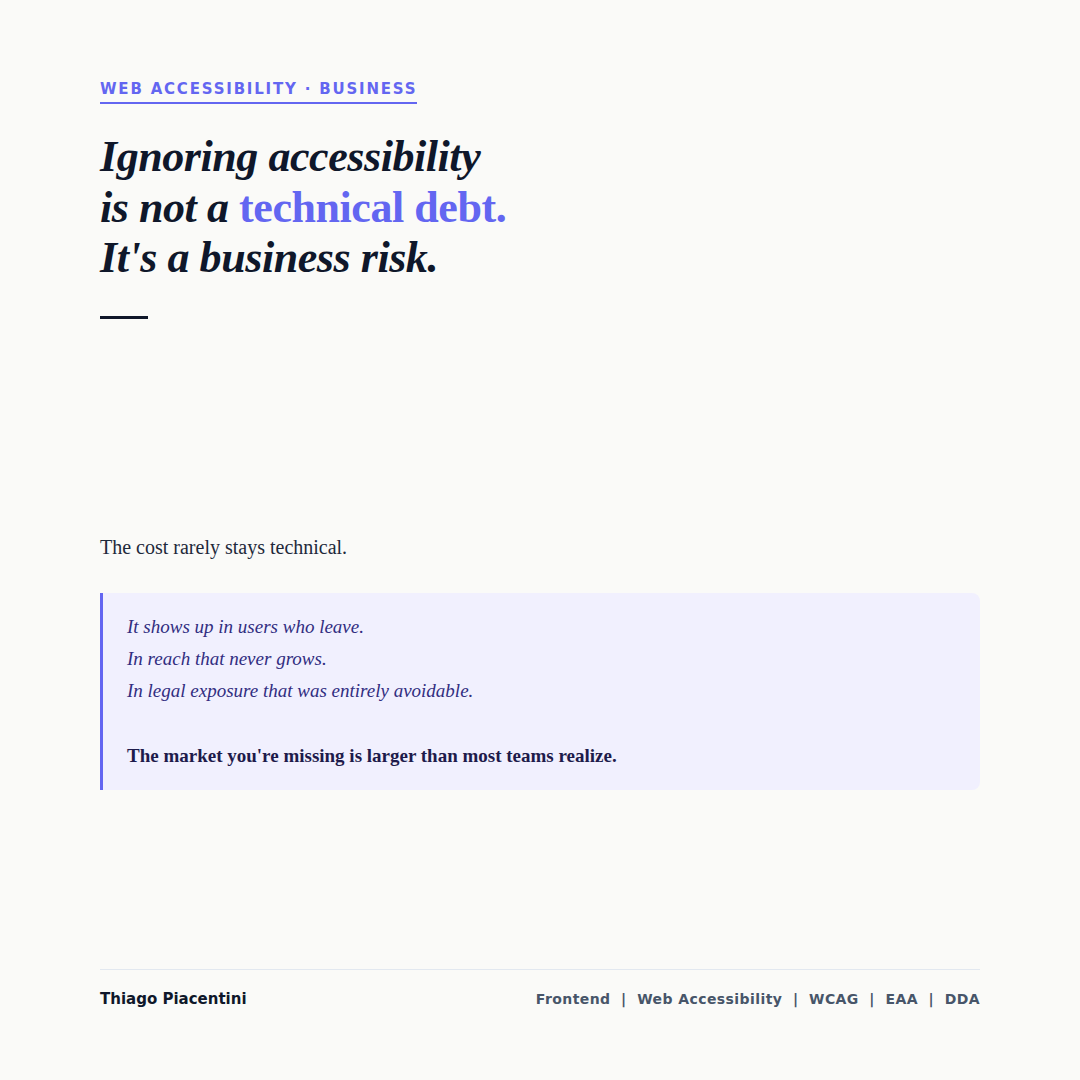
What the cost actually looks like
Users who leave — and never come back. When someone encounters a barrier — a form they can't navigate, a button they can't activate, an error message they can't read — they don't file a bug report. They leave. Quietly. And in most cases, they don't return.
Reach that never grows. According to the World Health Organization, over 1 billion people live with some form of disability. That's a significant portion of any potential audience. An inaccessible product isn't just excluding people — it's capping its own growth.
Legal exposure that was entirely avoidable. Regulations like the EAA (European Accessibility Act), the DDA (Disability Discrimination Act), and Brazil's LBI (Lei Brasileira de Inclusão — Lei nº 13.146/2015) are increasingly enforced. Accessibility compliance is no longer optional in many jurisdictions — and the organizations that treat it as optional are finding out the hard way.
The framing problem
"Technical debt" implies something to be scheduled and eventually paid. It suggests the product is working — just imperfectly.
But inaccessibility isn't a deferred improvement. It's an active exclusion. For the users it affects, the product isn't working at all.
That framing matters, because it changes how teams prioritize, and how we understand the risks.
A perspective worth considering
These are observations based on patterns I see in the industry — not absolute conclusions. Accessibility is a complex field and every context is different.
But from where I stand, the teams that treat accessibility as a business concern — not just a compliance checkbox or a developer responsibility — tend to build better products for everyone.
The market you're missing is larger than most teams realize.