Most teams treat accessibility as a final step — something to check before launch, or fix after an audit.
By then, the decisions that matter most have already been made.
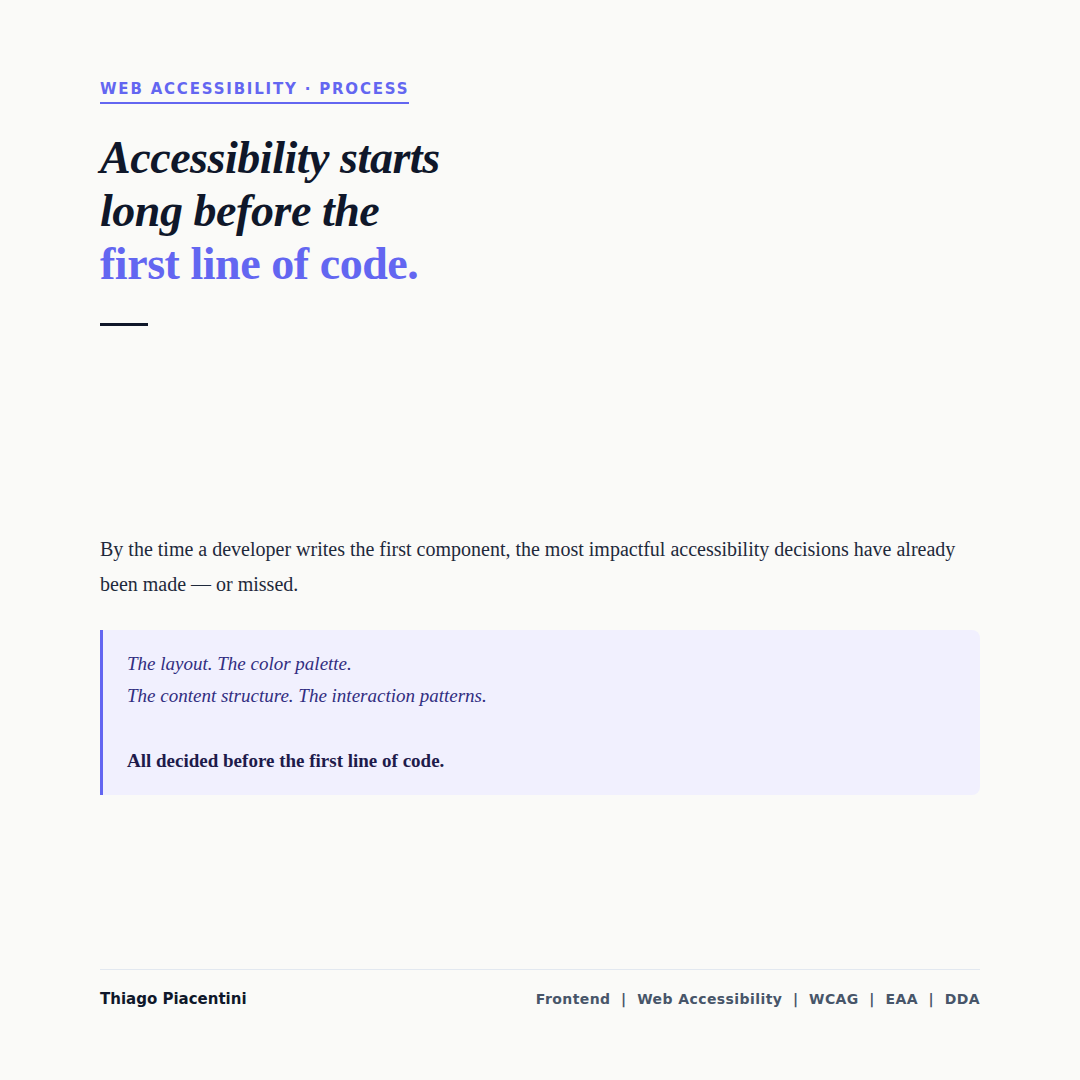
The layout, the color palette, the interaction patterns, the content structure. All locked in by the time a developer opens their editor.
Fixing accessibility at the end means redesigning decisions, not just fixing code. And redesigning decisions is expensive — in time, in team effort, and sometimes in the product itself.
Where the most impactful decisions happen
The choices that define whether a product is accessible or not are rarely made in code:
- In the wireframe — when information hierarchy is established
- In the color palette — when contrast ratios are either considered or ignored
- In the content spec — when labels, headings, and error messages are written
- In the component decision — when an interaction pattern is chosen
By the time a developer implements a design, those choices have already been made. The developer is executing decisions, not making them.
What shifting left actually means
When accessibility enters at the design stage, it stops being a correction and starts being part of the product.
A designer thinking about focus order while building a component saves a developer from discovering a keyboard trap in QA. A content writer who understands error message requirements prevents a failure from reaching production.
This isn't about adding steps to the process. It's about moving the conversation to where the decisions are still open — where changing something costs a comment in Figma, not a sprint of rework.
A question worth asking
At what stage does accessibility enter your process?
If the answer is "when we test" or "when we get a bug report" — the problem isn't technical. It's a process decision. And process decisions have process solutions.